
What an H100 Is Worth Today, and What It Teaches B300 and Vera Rubin Lenders
The H100 is the first AI GPU to run through a full lending cycle. Since it launched in October 2022, lenders have financed H100 nodes at shortage prices, watched rental rates halve, and seen Blackwell reprice the fleet. Loans written in 2023 are now three years into their terms. What that collateral is worth today is the best evidence we have for how to underwrite B300 now and Vera Rubin next.
This post is about fair market value today, not residual value. Residual value is what a node is worth at the end of its useful life. The more useful question for a lender is what the collateral is worth partway through the loan, when a covenant trips or a borrower defaults. Three years of H100 data answer that question: the sticker price told lenders little, the resale market repriced in jumps rather than curves, and condition mattered more every year.
A framing note first: data centers do not install GPUs, they install nodes. For the H100 SXM that means eight modules on one HGX baseboard. That is the unit operators buy, the unit lenders finance, and the unit this post tracks. PCIe cards trade in a different market and are not covered here.
What lenders underwrote: a sticker that stood still while the bid swung
From mid-2024 into early 2026, new H100s listed at roughly $25,000 to $40,000 per GPU, or $200K to $320K a node. On paper, it was the most stable asset price in data center history.
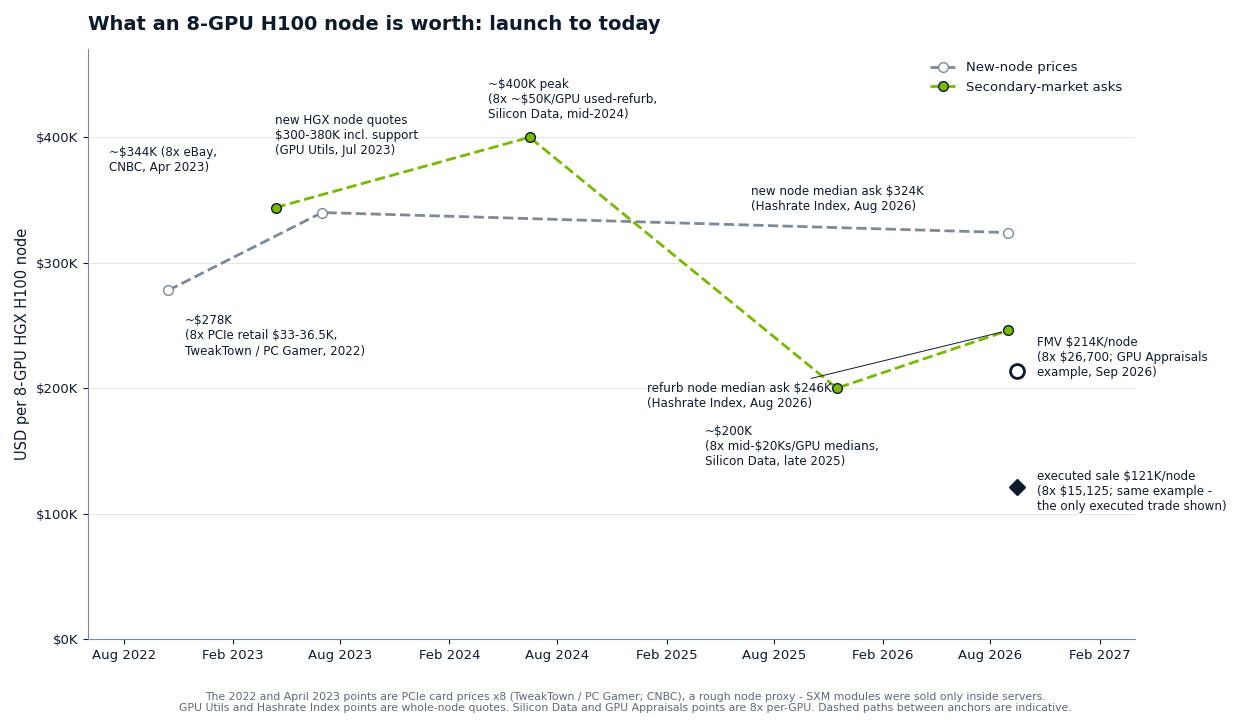
The secondary market told a different story, and it moved in both directions. In April 2022, before shipping began, a Japanese retailer took H100 preorders at about $33,000 to $36,500 per card (TweakTown, PC Gamer). A year later, eBay listings for H100 cards ran from about $40,000 to just under $46,000 (CNBC). By mid-2023, complete 8-GPU HGX H100 SXM servers were quoted at $300K to $380K depending on specs and support (GPU Utils). Silicon Data, which analyzed thousands of listings from June 2024 through December 2025, found used and refurbished H100s listed as high as $50,000 per GPU in mid-2024. That is roughly $400K a node, above the new-unit sticker. Asking prices then fell hard as supply returned and buyers regained leverage.
So the sticker was wrong both ways. In the shortage it understated what a node would fetch. A year later it overstated it. A lender who sized an advance off list price was marking collateral to a number the market had stopped paying attention to.
And note the word listed. Asking prices are not trades. They mark the top of the range, not the clearing price.
First lesson of GPU collateral: there is no sticker. There is a bid. The bid is the value.
What an H100 node is worth today
Look at the right edge of the chart. Hashrate Index's AI Hardware Price Index put the median asking price for a new 8-GPU HGX H100 node at $324K on August 31, 2026, and for a refurbished node at $246K. Both are asks, not trades. Our anonymized example appraisal put fair market value at $214K a node on an income approach. The executed secondary sale of that same equipment came in at $121K.
The gap between $214K and $121K is not an error. It is two different questions with two different answers.
Fair market value assumes a willing buyer and a willing seller, reasonable exposure to the market, and equipment valued for the income it can earn in place. An executed sale reflects the actual terms of one transaction: the seller's timeline, the lot size, the condition and warranty status of the units, and whether a lease or customer came with them. Change the premise and the number changes.
That is why a lender needs more than one number. In this example the executed sale was 57% of fair market value and 49% of the refurbished median ask. Those ratios are the haircut a credit file should plan for. An appraisal written for lending should report fair market value alongside an orderly liquidation value, so the committee sees both the earning-power number and the exit number before it sets an advance rate.
Now set those numbers against what was underwritten. A node financed in mid-2023 at $300K to $380K has a fair market value today of $214K, roughly 56% to 71% of its cost, or 63% at the midpoint. The executed sale recovered 36% of that midpoint cost. Rental assumptions fared worse: a model built on early-2024 rates of more than $7 per GPU-hour now faces rates under $3.
Four numbers for the same hardware, all defensible, all different. Which one belongs in a credit file depends on the question being asked, and answering that question is the appraiser's job.
The depreciation curve is not a schedule
Silicon Data's listing data shows how H100 asking prices behaved against the contemporaneous new price:
- In 2024, roughly two years after launch, used H100s were listed at a median of about 61% of the new price. Refurbished units held around 85%.
- In 2025, around the three-year mark, the used median was about 69% and refurbished about 84%. Another cut of the same dataset puts some three-year-old used units as low as 45% to 55% of new.
Read that again: the used median went up from year two to year three, while individual three-year-old units were listed at half of new. That is not a depreciation curve. It is a market repricing in jumps, driven by supply waves, new generations and pickier buyers. Measured against each unit's peak price instead, the same report finds two-year-old H100s retaining just 30% to 40% of their historical maximum, and three-year-old units 20% to 30%.
The one stable pattern is condition. Refurbished units were priced 15 to 25 percentage points above used units in every time bucket, and the gap widens as inventory ages. Buyers pay for certified, warranty-backed hardware.
Straight-line depreciation over five or six years captures none of this. The schedule is an accounting convenience. It is not an appraisal.
Cash flow is the other half of the number
Collateral value is what a buyer pays. A buyer pays for earning power, and a GPU's earning power is its rental rate.
That side of the market has been just as unstable. AIMultiple's rental index shows the median posted H100 rate falling from more than $7 in early 2024 to under $3 in 2026. Silicon Data's H100 Neo-Cloud index read $2.75 on July 27, 2026, up 7% since early May, and SemiAnalysis data shows one-year H100 contract rates rising from $1.70 to $2.35 per GPU-hour between October 2025 and March 2026. Both things are true: the rate has more than halved from the shortage peak, and it is rising again because demand keeps outrunning supply. On NVIDIA's August 26 earnings call, CFO Colette Kress guided fiscal 2028 revenue growth of about 70%, said customer forecasts point to demand roughly doubling, and called the outlook supply constrained.
Meanwhile the generation above is re-rating. Silicon Data's neo-cloud indices show the H200, with 141 GB of HBM3e against the H100's 80 GB, rising 14.4% in rental rate from May to late July 2026, twice the H100's 7.0%. Over those twelve weeks the H200 premium ran from 5% down to 0.4%, then up to a 16.2% peak. B200 spot sits higher still. When the newer chip earns 10% to 15% more per hour, the older chip's residual value is being repriced whether or not anyone updates the spreadsheet.
What actually moves residual value
Pull the threads together and three variables do most of the work:
- Generation position. Value tracks where the chip sits relative to the current frontier, not its age in months. Blackwell volume shipments repriced Hopper. The next transition will do it again.
- Memory content. The H200's premium is a memory premium. In an HBM-bottlenecked market, memory configuration is the difference between two collateral values.
- Condition and provenance. Warranty status, refurbishment history, thermal environment, utilization records. The condition spread widens every year the fleet ages.
None of this is knowable from a purchase invoice. All of it is measurable from current market data, if someone goes and measures.
What this means for B300 and Vera Rubin
The B300 is where the H100 was in 2023: newly shipping, supply-constrained and expensive. Hashrate Index put the median asking price for an air-cooled 8-GPU HGX B300 node at $544K on August 31, 2026, 1.68 times the new H100 ask.
Apply the H100 record as a stress case. If a B300 node bought at $544K follows the H100 path, its fair market value three years out would be about $343K (63% of cost), and a secondary sale like our example could bring about $196K (36%). That is illustrative arithmetic, not a forecast, but it is the scenario a credit committee should see.
The clock will likely run faster. The H100 had more than two years at the frontier before Blackwell reached volume. NVIDIA has since moved to an annual cadence: Vera Rubin began initial shipments in the third quarter of 2026 with volume ramp expected in the fourth quarter, and Rubin Ultra is planned for the second half of 2027. A B300 financed today will likely face its first generational repricing within about a year, not two.
Three lessons carry over:
- Size the advance to liquidation value, not cost or fair market value. In our H100 example the executed sale came in 43% below FMV.
- Front-load amortization. The steepest repricing comes when the next generation reaches volume, and for B300 that falls inside the first two years of a loan.
- Underwrite memory as a value driver. Rubin moves to HBM4. How much of B300's premium survives will depend on its 288 GB of HBM3e, just as the H200's 141 GB set its premium over the H100.
When Vera Rubin nodes are financed in volume, B300 will be where the H100 is today. The same questions will apply, on a faster clock.
Why this needs an appraiser, not a spreadsheet
A collateral value set at origination and left alone is a guess with a date on it. This market moves quarterly. The H200/H100 premium alone went from 0.4% to 16.2% within twelve weeks this summer.
A USPAP-compliant appraisal produces a fair market value as of a specific date, built from observable market data and documented well enough to survive a credit committee, an examiner or a workout. Paired with a liquidation value and refreshed on the cycle this market actually moves on, it turns the collateral column of a credit file from an assumption into evidence.
If you are lending against GPU infrastructure, the question is not what the equipment cost. It is what it is worth today, what it would bring if you had to sell it, and who documented those numbers.
GPU Appraisals issues USPAP-compliant appraisals of GPU infrastructure. For a directional number, try the quick estimate. For a defensible one, book 20 minutes.
Disclosure: GPU Appraisals is affiliated with GPU Capital LLC, a private credit fund that invests in GPU servers. As USPAP requires, GPU Appraisals discloses any current or prospective interest in the subject property or the parties to the client before accepting an assignment.
Sources
- TweakTown, H100 preorder listing at GDEP Advance, 2022
- PC Gamer, H100 preorders at about $36,000, 2022
- CNBC, H100 chips selling for more than $40,000 on eBay, April 14, 2023
- GPU Utils, Nvidia H100 GPUs: Supply and Demand, July 2023
- Silicon Data, The Illusion of Stability: Unpacking H100 GPU Market Value Trends, January 30, 2026
- Silicon Data, H200 vs H100 Rental Prices, May to July 2026, August 4, 2026
- AIMultiple, Cloud GPU Rental Price Index, May 2026 update
- Akash Network, H100 Rental Price in August 2026, citing SemiAnalysis contract data
- Hashrate Index, Introducing the AI Hardware Price Index, August 31, 2026
- Vipera, Supermicro SYS-821GE-TNHR HGX H100 listing, September 2026
- NVIDIA fiscal Q2 2027 earnings call (quarter ended July 26, 2026), coverage via Zacks
- Digital Citizen, NVIDIA confirms Vera Rubin launch for Q3, 2026
- DatacenterDynamics, Nvidia announces Vera Rubin Superchip, including Rubin Ultra timing
- VRLA Tech, NVIDIA GPU Roadmap 2026-2030, B300 memory specifications
Rental and resale figures are third-party market observations, not appraisals of any specific equipment. This article is market commentary, not an appraisal or investment advice.