
Did GPU Node Values Actually Change?
For: Lenders, CFOs and operators carrying GPU nodes
On Wednesday, October 14, the market repriced AI operators. CoreWeave's stock fell 15.5% in a day and its 9.625% 2032 bonds traded at a 14.8% yield to maturity. Nebius dropped 10%, Oracle 9%, and the Nasdaq 1.9%. Reuters traced the trigger to hot CPI data and rate-hike bets, and put CoreWeave down about 25% in October. That is the setup. The question I care about is narrower: did the value of the GPU nodes themselves change? My read is no, not yet.
What a node is worth
I value hardware as a whole node, never per card. An 8-GPU server is the unit that rents, finances and resells, so it is the unit that gets an opinion.
A node is worth what it can earn and what it would cost to replace. Earnings power comes from contract rental rates. Replacement cost caps what a buyer will pay for a used node, because a buyer can always purchase new. Financing costs and the owner's balance sheet are not in that definition. They change who can hold the node and how long they can afford to hold it. They do not change what the node produces.
Rental rates went up
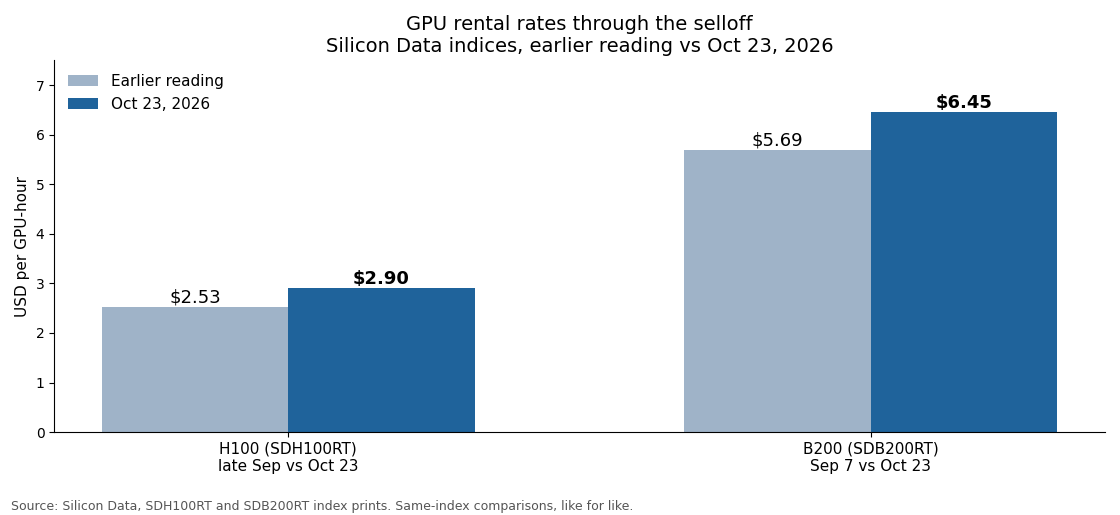
Silicon Data's indices tell a plain story. The H100 index printed $2.90 per GPU-hour on Oct 23, against about $2.53 in late September. That is roughly 15% higher. The B200 index printed $6.45, against $5.69 on Sep 7, up about 13%. Both were measured from the same indices, so this is like for like.
On an 8-GPU node, the H100 move is about $2.96 more per node-hour, or roughly $26,000 more per year at full utilization. That is a gross figure, before power, hosting and downtime. I am not claiming the market has repriced H100 nodes up 15%. A two-week index move is a data point, not a trend. I am saying the cash flow evidence through October 23 pointed up, not down.
The term structure matters too. On Sep 7 the B200 12-month term rate sat at $5.39, about 5% below spot. A discount like that says buyers expect rates to ease from here. I watch that gap more closely than the spot print, because it is the forward view on earnings power. I will flag if it widens.
Replacement cost did not move
For an 8-GPU H100 node, 2026 price guides run roughly $250,000 to $320,000. CloudZero's H100 cost guide is one public anchor. Nothing in the selloff changed what Nvidia, Supermicro or Dell charge for a new server. A rate-hike scare does not reprice a bill of materials.
So both legs of node value held. Earnings were flat to higher, and the ceiling from replacement cost was untouched.
One caveat on that ceiling: it is a ceiling, not a floor. If the next generation ships at a lower price per unit of compute, the ceiling comes down for the current one. That is a product-cycle risk, not a credit-market risk, and it was not in play in this selloff.
What did change
Two things changed, and neither is on the node.
First, the cost of financing a node. A bond yielding 14.8% tells you what the market charges an AI operator for debt today. A borrower paying that rate needs a higher yield on every node it adds, and some projects that cleared last month no longer clear.
Second, the odds that a debt-heavy owner becomes a forced seller. This is where node values can move, and the mechanism is the thin secondary market. Data Gravity counts only about $26M of GPU collateral sales in three years. That is a handful of nodes by fleet standards. With so few trades, one motivated seller can set the comparable. A lender liquidating 200 nodes into a market that has seen $26M in three years does not get an average price. It gets a discount, and the next appraiser sees that print.
That is the path from a credit selloff to a lower node value. It runs through a sale, not through a headline. Until a distressed sale or an estate sale clears below the pack, the evidence says values held.
What I am watching
In a week like this, I check four things:
- Contract rental rates, which are the cash flow.
- The 12-month term rate against spot, which is the forward expectation.
- Replacement cost of the current generation.
- Any sign of distressed or estate sales.
Only the fourth could break the valuation, and I have not seen it yet. For when a falling value triggers an accounting charge, see our post on GPU impairment and node fleet write-downs. For why book life and economic life diverge, see GPU depreciation: accounting vs economic life.
What lenders and CFOs should do
Do not mark nodes down because the borrower's bonds sold off. The evidence does not support it, and a markdown built on sentiment is one you will have to reverse.
Do separate two questions you may have bundled. One is what the node is worth. The other is whether the owner can hold it. Underwrite the second one now: look at the operator's refinancing dates, covenant headroom and cash runway against a 15% cost of debt.
If you hold collateral, ask for contract rental rates and term quotes on each node, and re-appraise any pool where the borrower is stressed. If a forced sale is plausible, get a whole-node valuation before it happens, not after. The first distressed print will become the comparable for everyone else's book.
GPU Appraisals values whole nodes for lenders, lessors and CFOs. If you want a current opinion on a pool, contact us at gpuappraisals.com.
Disclosure: GPU Appraisals is affiliated with GPU Capital LLC, a private credit fund that invests in GPU servers. As USPAP requires, GPU Appraisals discloses any current or prospective interest in the subject property or the parties to the client before accepting an assignment.
Sources
- Silicon Data, H100 rental index (SDH100RT): silicondata.com/products/silicon-index/h100
- Silicon Data, B200 rental index (SDB200RT): silicondata.com/products/silicon-index/b200
- CNBC, Oct 14, 2026, CoreWeave stock and bond yields: cnbc.com/2026/10/14/coreweave-stock-bond-yields-ai-debt.html
- Reuters via US News, Oct 14, 2026, AI infrastructure firms slump on rate-hike bets: money.usnews.com/investing/news/articles/2026-10-14/ai-infrastructure-firms-slump-as-us-rate-hike-bets-rise
- CloudZero, H100 GPU cost: cloudzero.com/blog/h100-gpu-cost
- Data Gravity, How the GPU became collateral: datagravity.dev/p/how-the-gpu-became-collateral
Derived figures (percentage changes, annualized node revenue) are my estimates from the index prints above.
Marek Omilian | Managing Director | Value Prism Consulting